
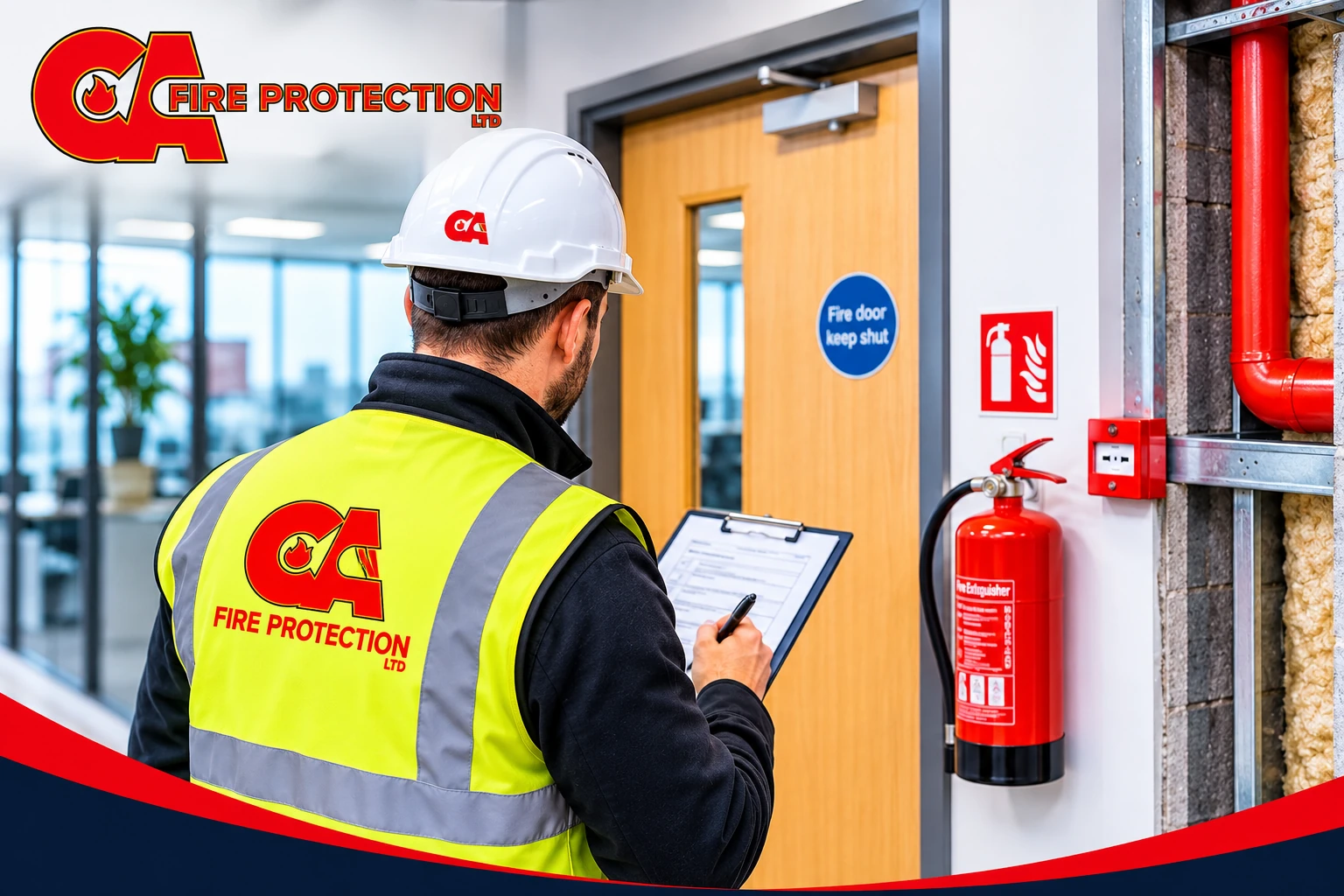
Objective
This guide will help you understand how to choose a reliable contractor and learn about passive fire protection work and what the law expects of you.
Key takeaways
- If you control a business building in England, you are probably the Responsible Person.
- From 1 October 2023, every business must record its fire risk assessment in full.
- Fire doors, sealed gaps, and cavity barriers slow a fire down while help arrives.
- Ask any contractor for certificates you can check.
Introduction
Most business owners in Essex and Surrey have an extinguisher by the door and an alarm on the ceiling. Far fewer know what is happening inside the walls, floors, and ceiling voids.
Did you know? Fire and rescue services in England attended 13,679 fires in buildings other than homes in the year ending March 2026, according to GOV.UK statistics.
If you run, own, or manage commercial premises, the law usually makes you the responsible person, and gaps in your fire protection are your problem. This guide explains how commercial fire protection services work, what the law expects, and how to check your building before an inspector does.
In this guide
- Know Your Legal Duty Before an Inspector Asks
- What Fire Protection Work Happens Behind Your Walls and Ceilings
- Fire Doors: Quick Checks That Catch Costly Faults
- What Essex and Surrey Fire Services Expect From Your Business
- How a Passive Fire Protection Survey Works, Step by Step
- How to Pick a Contractor You Can Check Up On
- Fix the Hidden Gaps Before Someone Else Finds Them
- FAQs
Know Your Legal Duty Before an Inspector Asks
Here’s the thing: fire safety law doesn’t care how big you are. The Regulatory Reform (Fire Safety) Order 2005 covers most non-domestic buildings in England and Wales. Under it, the responsible person is whoever controls the premises: the employer, owner, landlord or occupier. Shared buildings often have several. In an office block, that can mean the owner, the managing agent, and each tenant.
Now the part many people miss. Since 1 October 2023, every Responsible Person must record their fire risk assessment in full, whatever the size of the business. Essex County Fire and Rescue Service said in 2023 that most small retailers whose premises its crews visited didn’t know. GOV.UK gives a plain example: a shopkeeper with one part-time assistant now has to write it down.
Get it wrong, and the cost is real. For serious breaches, the penalty is an unlimited fine, and at the Crown Court it can also be up to two years in prison, according to GOV.UK.
What Fire Protection Work Happens Behind Your Walls and Ceilings
Let’s break it down. Commercial fire protection services help stop fire and smoke from spreading through a business building. Active protection spots or fights a fire, such as alarms and sprinklers. Passive fire protection is built into the structure and slows a fire down. We install and maintain passive systems, so that’s our focus here.
Why does it matter? GOV.UK reports that fire crews in England took 9 minutes 12 seconds on average to reach fires in non-home buildings in the year to March 2026. What this really means is your walls, floors, and doors must hold for those minutes.
Use this table to match what you notice to the fix:
| What you notice | What it may mean | What to ask about |
|---|---|---|
| Gaps around cables or pipes in a wall or floor | Fire and smoke can pass through. | Firestopping |
| A door that won’t close by itself | It can’t hold back smoke. | Fire doors |
| Bare steel after a refit | The steel has no protection. | Intumescent coating |
| Hidden voids above ceilings | Fire can travel unseen. | Cavity barriers |
| Noise carrying between rooms | Gaps in the wall | Acoustic barriers and seals, which can add fire sealing too |
Fire Doors: Quick Checks That Catch Costly Faults
A fire door is a full set: door, frame, seals, hinges, and closer. A solid door with a broken closer won’t do the job.
Surrey Fire and Rescue Service advises checking fire doors at least every six months, and more often in busy areas. Try this: open the door fully, let go, and see if it closes and latches by itself. Look at the seals. Check that nobody has wedged it open. The quarterly checks you may have read about apply to blocks of flats, not offices or shops.
Run a site in the capital too? We cover London, so fire door London enquiries are welcome.
What Essex and Surrey Fire Services Expect From Your Business
Your local fire and rescue service enforces the law, and it can visit. GOV.UK says inspectors may enter at any reasonable time and ask to see your records.
For fire protection in Essex, Essex County Fire and Rescue Service’s Fire Protection Officers audit fire risk assessments and related paperwork, then tell you how compliant you are. For fire protection in Surrey, Surrey Fire and Rescue Service offers free Business Safe and Well Visits for small, simple premises. It’s a chat built around eight questions, and it isn’t meant to enforce the law.
Here’s the catch. Neither service will write your assessment for you. GOV.UK says fire authorities can advise but can’t carry it out. That’s when you need a competent person and, for hidden gaps, a survey. We also have pages for Essex and Surrey.
How a Passive Fire Protection Survey Works, Step by Step
A passive fire protection survey checks that the fire-resisting parts of your building are in place and in good order. A good one usually runs like this:
- Paperwork: your fire risk assessment, drawings, and records of past works.
- Walk-round: ceiling voids, risers, service openings, and doors.
- Report: photos, locations, and what to fix first.
- Repairs and certificates, which you keep with your assessment.
Here’s a scenario. An electrician runs new cables through a plant-room wall during a refit and leaves the hole open. Nobody notices for two years. A survey is built to catch exactly this. (It’s an example, not a real case.)
Want a head start? Try this 20-minute check:
- Name the Responsible Person for each part of your building.
- Find your fire risk assessment and check that it is recorded in full.
- List any works done since it was written.
- Walk your fire doors.
- Ask past contractors for firestopping certificates.
You can read more on our passive fire protection surveys page.
How to Pick a Contractor You Can Check Up On
Choosing commercial fire protection services is easier when you ask for proof, not promises. Ask these questions:
- Who certifies the work? At CA Fire Protection, our installers are BM TRADA certified, and IFC and BM TRADA audit our work. See our accreditations.
- Who turns up? Our engineers are DBS-checked, and our staff hold NVQ Level 2 and CSCS cards.
- What goes into your building? Products tested to UK and European standards.
- What do you get at the end? Certificates and records.
- How fast can they start? We hold stock at our branches for short-notice projects.
If a firm names a certifier, check it with the certifier directly.
Fix the Hidden Gaps Before Someone Else Finds Them
Most fire protection problems sit where nobody looks: above ceilings, inside walls, around old cable runs. Start with the 20-minute check, then book a survey if anything worries you. Good commercial fire protection services give you certificates, clear reports, and work you can trust, not a quick patch.
Ready to book? CA Fire Protection offers a free, no-obligation quote and site survey. Call us or get in touch with CA Fire Protection.
Frequently Asked Questions
Who is responsible for fire safety in a commercial building?
The Responsible Person: Employer, Owner, Landlord, or Occupier who controls the premises. In shared premises, there may be more than one responsible person, and they must work together.
Do small businesses need a written fire risk assessment?
Yes. From the 1st of October 2023, the responsible person needs to document their fire risk assessment, regardless of the size of the business.
What is the penalty for breaking fire safety law?
For serious breaches, the UK government states an unlimited fine can be given at the magistrates’ court. At the Crown Court, it can be an unlimited fine, up to two years in prison, or both.
What is the difference between active and passive fire protection?
Active protection spots or fights a fire and includes things like alarms or sprinklers. Passive protection is built into the structure to slow a fire down and can include things like fire doors or barriers.
How often should fire doors be checked?
Surrey Fire and Rescue Service says at least every 6 months, and more frequently in busy areas. The frequency should be determined by the fire risk assessment.