
Objective
This blog provides information on the ways that commercial fire protection services can protect your company from financial losses in legal fees, as well as permanent closure. We discuss the actual cost of fire, what protection really entails, and how to be in compliance with UK law.
Key Takeaways
- A major workplace fire costs an average of £657,074, and roughly 25% of affected businesses never reopen.
- Commercial fire protection services cover both active systems (like commercial fire sprinkler services and fire alarm system maintenance) and passive systems (fire stopping, fire doors, and intumescent spraying).
- UK law requires every business to carry out a fire risk assessment and maintain adequate protection measures.
- Choosing an accredited contractor with third-party certification is not optional; it is your proof of due diligence.
Introduction
A fire does not just damage your property; it can erase your business overnight.
Here is the thing: many owners and facility managers focus on active systems like alarms and sprinklers, whilst overlooking passive fire protection. Yet it is the passive measures- fire stopping, compartmentation, and fire door integrity- that actually contain a fire and give your occupants time to escape.
The solution is straightforward. Professional Commercial Fire Protection Services address both the visible and hidden risks in your building, ensuring you meet UK law and protect your bottom line.
Did you know? According to the latest government data, fire and rescue services attended 6,665 fires in non-residential buildings in 2024/25. The average cost of a major workplace fire incident is estimated at £657,074, and roughly a quarter of fire-affected businesses never reopen.
Table of Contents
- The Real Cost of Fire: Why Your Balance Sheet Is at Risk
- What Commercial Fire Protection Services Actually Include
- What UK Law Demands of You
- How to Choose the Right Fire Protection Partner
- Do Not Wait for the Alarm to Sound
- Frequently Asked Questions
The Real Cost of Fire: Why Your Balance Sheet Is at Risk
Let us break it down. When a fire hits a commercial property, the damage goes far beyond charred walls.
Direct costs include building repairs, equipment replacement, and stock loss. Then there is the downtime, weeks or months where you cannot trade. On top of that, authorities issued 2,972 formal enforcement notices in the latest year, and fire safety prosecutions rose by 79% in 2023/24. The fines are unlimited, and in extreme cases, negligence can lead to prison time.
Imagine you run a small warehouse in Kent. A fire starts in the storage area. Without proper fire stopping, it spreads through cable penetrations into your office within minutes. You lose stock, equipment, and three months of trading. The total bill? Far more than the cost of installing proper protection in the first place.
What this really means is that fire protection is not an expense. It is insurance against losing everything you have built.
What Commercial Fire Protection Services Actually Include
Commercial fire protection services are the professional measures that keep your building, your people, and your operations safe from fire. They split into two distinct categories.
Active systems detect and suppress fires. These include commercial fire sprinkler services, fire alarm system maintenance, and extinguishers. They are your first response.
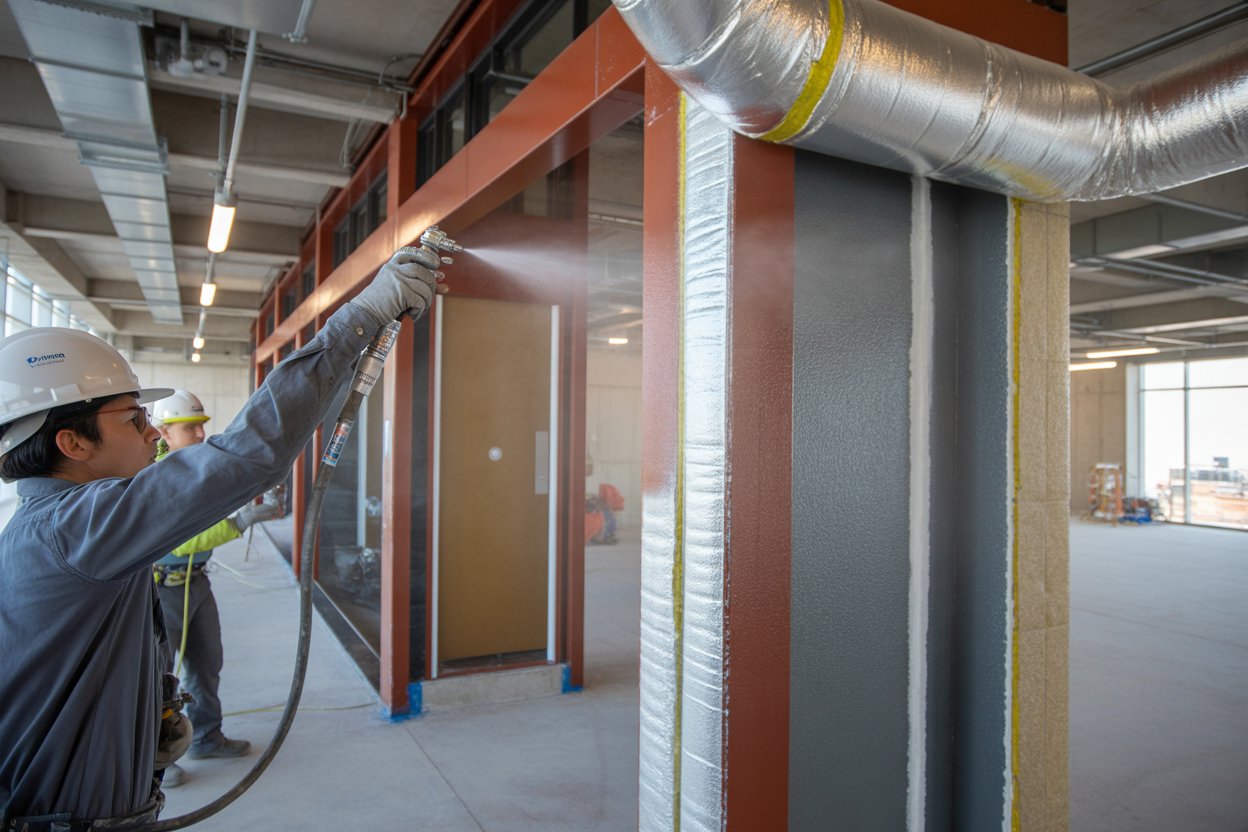
Passive systems contain fire and protect your building’s structure. This is where CA Fire Protection specialises. Our work includes fire stopping to seal penetrations, compartmentation to divide buildings into fire-resistant cells, intumescent spraying to protect structural steel, and certified fire door installation.
In that case, why does passive matter so much? Because active systems can fail. Sprinklers might not activate immediately. Alarms might be ignored. Passive protection works silently, 24 hours a day, containing the fire so people can get out and the structure stays standing.
What UK Law Demands of You
Under the Regulatory Reform (Fire Safety) Order 2005, every business must have a “responsible person” who carries out a fire risk assessment and implements adequate safety measures. This includes maintaining both active and passive systems.
Here is a statistic that should concern you: only 58% of fire safety audits were judged satisfactory. That means 42% of businesses inspected had failings. The most common breaches involve blocked escape routes, faulty fire doors, and inadequate general fire precautions.
If your business is one of the 42%, you are exposed to enforcement action, fines, and potentially losing your insurance cover.
How to Choose the Right Fire Protection Partner
When you need emergency fire protection services or planned upgrades, the contractor you choose matters. Here is what to look for:
| What to Check | Why It Matters |
| Third-party accreditation (IFC, BM Trada, BAFE) | Proves the work meets UK and European standards |
| NVQ-qualified, CSCS-accredited engineers | Guarantees technical skill and site safety |
| DBS-checked staff | Essential for schools, hospitals, and care homes |
| Stock holding and 24/7 availability | Means works can start quickly when deadlines loom |
| Written certification on completion | Required for your fire risk assessment file and insurance |
Ask these questions before you sign anything. A proper contractor will answer them without hesitation.
Do Not Wait for the Alarm to Sound
Fire risk is not a hypothetical problem. It is a statistical certainty for thousands of UK businesses every year. The good news? Costly fire risks are entirely preventable when you work with the right accredited partner.
Get your free, no-obligation fire protection survey and quotation today. Call CA Fire Protection or fill out our contact form. We will inspect your premises, identify your compliance gaps, and give you a clear plan to protect your people, your property, and your livelihood.
Frequently Asked Questions
What is the difference between active and passive commercial fire protection services?
Active systems detect and suppress fires, think commercial fire sprinkler services, fire alarm system maintenance, and extinguishers. Passive systems contain fire and protect your building's structure through fire stopping, fire doors, and intumescent spraying. You need both.
How often should fire doors be inspected in a commercial building?
UK best practice advises checking fire doors at least every six months in areas with high traffic as well as annually in less-traffic areas. Damage to hinges, seals, or self-closing devices should be addressed immediately.
What accreditations should a fire protection contractor hold?
Look for third-party accreditation through IFC, BM Trada, BAFE SP203, or ASFP. Engineers should have NVQ 2 or Level 2 qualifications as well as CSCS cards. For sensitive sites, DBS checks are essential.
Are commercial fire protection services a legal requirement?
Yes. According to the Regulatory Reform (Fire Safety) Order of 2005, the person responsible must conduct an assessment of fire risks and take general fire safety precautions which include the maintenance of actively and passive safety measures.
How quickly can emergency fire protection works start?
Reputable contractors can mobilise within days if they hold stock and offer 24/7 availability. Emergency fire protection services are critical when you face an enforcement deadline or insurance condition.