
Objectives
- The program provides training to commercial property owners and facilities managers about passive fire protection surveys.
- The program requires an explanation of the UK legal requirements which exist under the Regulatory Reform (Fire Safety) Order 2005.
- The program needs to show people about the results which happen when they do not comply with regulations and the advantages which come from conducting regular inspections.
- The website needs to achieve first position for the keyword ‘Passive Fire Protection Surveys’ and all related search terms.
- The survey inquiry and booking page of CA Fire Protection needs to receive qualified leads from the existing sources.
Key Takeaways
Before you read on — here’s what you’ll learn:
- Legal Duty: All commercial buildings in the UK must have their passive fire protection regularly inspected under the Regulatory Reform (Fire Safety) Order 2005.
- Life Safety: Passive fire protection can contain fire for up to 120 minutes — buying critical evacuation time.
- The inspection process includes testing fire doors and firestopping systems and cavity barriers and intumescent products and structural steel protection systems.
- Every commercial building requires this service which includes offices and schools and hospitals and hotels and retail units and residential blocks.
- The service should be conducted at least once every year and also after every construction project and refurbishment.
- The process requires you to hire an FDIS-certified inspector together with an accredited passive fire protection contractor to obtain expert assistance.
Introduction
Each year fires cause fatal damage to commercial buildings throughout the United Kingdom which results in loss of human life and destruction of businesses and their assets. The majority of these tragedies which occur can actually be prevented. The most effective method for fire safety protection exists with passive fire protection which remains unrecognized by many people.
Fire protection systems use fire alarms and sprinkler systems to activate their functions when fires occur while buildings depend on passive fire protection to function silently throughout their entire existence. Fire protection systems create barriers which divide different areas of a building to limit fire and smoke movement while giving occupants essential time for safe escape.
Table of Contents
- What Is Passive Fire Protection?
- What Is a Passive Fire Protection Surveys?
- Why Are Surveys Critical for Commercial Buildings?
- Who Needs a Passive Fire Protection Surveys?
- What Does a Survey Involve? (Step-by-Step)
- How Often Should You Have a Survey?
- [MID CTA] Book Your Free Survey Today
- Is Your Building Really Protected? (Q&A Section)
- How to Choose the Right Passive Fire Protection Contractor
- Don’t Let a Hidden Gap Put Your Building at Risk (Conclusion)
- Final CTA — Get in Touch
- Frequently Asked Questions
What Is Passive Fire Protection?
The entire field of passive fire protection consists of building materials which provide protection against fire through their installation into building construction. The building’s structure provides permanent fire and smoke protection through its passive design which operates without interruption.
The essential components of passive fire protection systems include:
- Fire-rated walls, floors, and ceilings that create fire compartments
- Fire doors and frames which create sealed escape routes that protect against fire
- Intumescent seals and strips which expand in heat to create protective barriers that block gaps
- Firestopping materials which protect pipes and cables and ducts from flames
- Cavity barriers which protect open spaces inside walls and roofs
- Structural fire protection systems which safeguard steel beams and columns
The design elements create a system of firesafe compartments which protect building sections from fire spread for 30 to 60 or 120 minutes.
What Is a Passive Fire Protection Surveys?
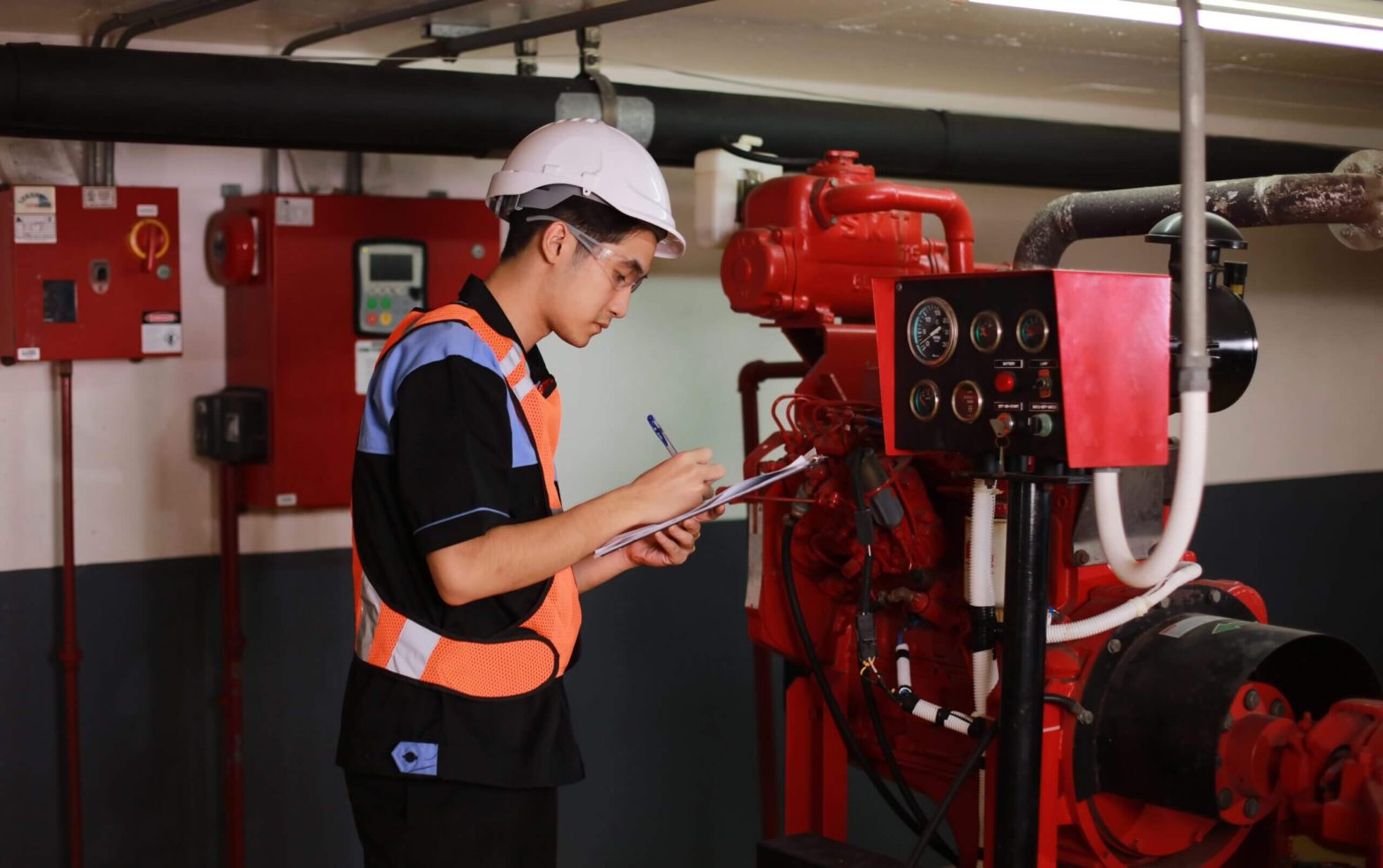
A passive fire protection surveys assesses all passive fire protection components which exist in your commercial building through expert inspectors who conduct their assessments based on established safety standards. The certified inspectors perform their evaluation by checking whether each component has been installed and maintained and meets its intended function.
A survey is not a quick tick-box exercise. The inspection process will include an examination of:
- The fire door system which includes its current condition and all opening seals and closing mechanisms and door frames and all required fire door signs
- Penetration seals — around all pipes, cables, and ducts passing through walls and floors
- Cavity barriers — within roof spaces, floor voids, and external wall systems
- The fire stopping system which includes mortar and boards and wraps and collars that protect service penetrations
- Structural steel protection — intumescent coatings and board systems
- Fire-rated glazing and curtain walling systems
The outcome produces a comprehensive report which contains visual documentation to show all aspects that meet requirements and all aspects that need correction and their necessary corrective procedures ranked according to their importance.
Why Are Surveys Critical for Commercial Buildings?
Legal Compliance
The Responsible Person for all commercial premises must ensure that all fire safety systems function properly according to the Regulatory Reform (Fire Safety) Order 2005. This requirement specifically covers passive fire protection systems.
Noncompliance results in:
- The Fire and Rescue Authority issues enforcement notices
- Organizations face unlimited fines and faced with business closure sanctions
- Criminal prosecution occurs when someone shows extreme negligence
- Civil liability arises when occupants suffer harm because of the situation.
Life Safety
The UK fire statistics show that most fire deaths happen because people inhale poisonous smoke instead of being burned by flames. The system of passive fire protection successfully contains smoke as it does fire which helps maintain clear escape paths while decreasing the danger of smoke-related injuries.
Insurance Validity
The insurance companies that cover commercial properties now demand proof of active fire risk assessments together with passive fire protection evaluations before they will provide coverage. The absence of written proof will lead to claim denial which results in substantial monetary losses for you.
Who Needs a Passive Fire Protection Surveys?
The situation requires a passive fire protection survey because the building contains more than one floor and multiple occupancies and shared escape routes. This includes:
- Offices and business parks
- Schools, colleges, and universities
- NHS hospitals and private healthcare facilities
- Care homes and supported living premises
- Hotels, hostels, and holiday accommodation
- Retail units and shopping centres
- Warehouses and industrial facilities
- High-rise and purpose-built residential blocks
- Student accommodation and HMOs
The post-construction surveys hold vital importance in building projects. Any building or refurbishment work — from laying new cables to installing a new kitchen — can breach fire compartmentation, even unintentionally. The post-works survey process establishes a method for detecting fire safety violations which must be corrected before building occupancy begins.
What Does a Survey Involve?
Here is what to expect when you commission a passive fire protection survey from a professional contractor:
Pre-Survey Preparation
The inspector reviews your building’s floor plans, existing fire strategy, previous survey reports, and building log book. This process guarantees that the inspection will focus on specific areas while ensuring all locations receive evaluation.
Systematic Physical Inspection
The inspection team conducts a complete building walkthrough to check all passive fire protection systems according to an established checklist. The team documents every defective component along with all identified gaps and all elements that do not meet requirements.
Photographic Documentation
All identified problems receive photographic documentation which includes geo-tagging to their exact building location, establishing an unchallengeable visual record.
Risk Prioritisation
The defect assessment process produces three priority categories to determine which resources require immediate attention while the other two categories need less urgent work.
Detailed Survey Report
You receive a comprehensive, plain-English report covering:
- A complete overview of all sections that meet compliance standards
- A prioritised list of all defects with photos and locations
- Clear recommendations for remedial works
- An estimated programme for completing remediation
Quality contractors provide digital reporting systems that enable you to monitor project status through live updates while obtaining remote access to reports and sharing information with your extended team and insurance companies.
How Often Should You Have a Survey?
The industry standard requires that building inspection frequency should be scheduled as follows:
- Annual surveys for most commercial buildings as a minimum
- Post-construction or post-refurbishment surveys after any building works
- Post-incident surveys following any fire, flood, or structural event
- High-risk buildings require more frequent inspections which should occur every six months with hospitals and high-rise residential buildings and schools needing this schedule
The Responsible Person must conduct fire door inspections which should be done between formal surveys to maintain safety standards. Many insurers and local fire authorities also expect to see documented evidence of regular interim checks.
Is Your Building’s Fire Protection Up to Standard?
Don’t Wait for a Fire to Find Out.
CA Fire Protection provides professional passive fire protection surveys for commercial buildings across London, Kent, Surrey, and Essex.
Free, No-Obligation Survey Certified FDIS Inspectors Same-Day Quotes
📞 Call Now: 0808 223 0422
Is Your Building Really Protected?
Building owners and facilities managers express identical concerns regarding passive fire protection surveys. The following section presents answers to the most frequently asked questions which we encounter.
My building passed a fire risk assessment last year — do I still need a passive fire protection survey?
The answer is yes. A fire risk assessment (FRA) serves as a comprehensive evaluation which assesses the fire hazards and fire safety management procedures throughout your facility. A passive fire protection survey is a specialist, in-depth technical inspection of the structural fire-resistant elements. The two systems serve different functions which require both systems to be present. An FRA will flag if passive fire protection needs attention, but only a specialist survey will tell you exactly what is defective and where.
Our building is brand new — surely the passive fire protection is already compliant?
Not necessarily. New buildings can and do have passive fire protection defects — from installation errors to materials that don’t meet specification. Post-completion surveys are strongly recommended for any newly constructed or refurbished commercial building before full occupation.
We had some electrical work done recently. Could that have affected our fire protection?
The answer is yes because cables passed through walls and floors. Fire-rated elements require proper firestopping methods for all penetrations because these methods protect the compartment’s structural integrity. Electricians and other trades are not always aware of — or properly trained in — firestopping requirements. The post-works survey will detect all breaches and fix them.
How disruptive is a passive fire protection survey?
The answer is minimal. Inspectors from our team complete their tasks in an efficient manner which creates little disturbance to your regular business activities. Most surveys can be carried out during normal working hours, and access requirements are agreed in advance. The process requires no single document to be filed
How to Choose the Right Passive Fire Protection Contractor
Not every fire safety company is qualified to carry out passive fire protection surveys. Here is what to look for:
- FDIS (Fire Door Inspection Scheme) certified inspectors for fire door assessments
- Membership of ASFP (Association for Specialist Fire Protection) or NAPFIS
- BM Trada or equivalent third-party accreditation for installation quality
- CSCS certified operatives for all site-based work
- Constructionline or CHAS registration for supply chain compliance
- A proven portfolio of completed commercial surveys across your building type
- Digital reporting capabilities for real-time access to survey data and photographic evidence
A reputable contractor will also offer end-to-end services — not just the survey, but the remedial works too. This gives you a single point of accountability and avoids the delays that come from coordinating multiple contractors.
Don’t Let a Hidden Gap Put Your Building — and Everyone In It — at Risk
CA Fire Protection provides the best fire protection services which deliver operational safety functions to clients. The company offers 35 yThe design of passive fire protection systems makes them completely unnoticeable to observers. Fire protection systems operate from behind plasterboard walls and inside building cavities and underneath fire door installations which they maintain throughout all operational hours of the day. The active fire protection system functions as the primary defense mechanism.
Passive fire protection systems maintain their functionality until they reach their silent failure point. The first problem arises from the absence of an intumescent collar. The second problem exists because the cable penetration point remains unsealed. The third problem occurs when a fire door fails to close itself properly. The system operates without notice but can lead to disastrous results from a minor incident.
A passive fire protection survey performed by a qualified expert provides proof that your building achieves actual protection which extends beyond mere documentation. The safety and compliance and resilience defense of your commercial building represents one of the best business investments you can make.
years of industry experience combined with complete accreditation while proving its capability through successful projects in multiple UK locations, including offices, schools, hospitals, and residential areas.
Book Your Free Passive Fire Protection Survey Today
Ready to Protect Your Building?
CA Fire Protection offers FREE, no-obligation passive fire protection surveys for commercial buildings across London, Kent, Surrey, Essex, and surrounding areas.
✅ Expert FDIS-Certified Inspectors
✅ Comprehensive Written Reports with Photos
✅ Full Remedial Works Available
✅ BM Trada | NAPFIS | ASFP | IFCC Accredited
0808 223 0422
info@cafireprotection.co.uk
cafireprotection.co.uk
Frequently Asked Questions
What is a passive fire protection survey, and is it the same as a fire risk assessment?
No — they are different but complementary. A fire risk assessment (FRA) is a broad overview of all fire hazards, safety measures, and management procedures within your building. A passive fire protection survey is a specialist, in-depth technical inspection focused specifically on the structural fire-resistant elements built into your building — such as fire doors, firestopping, cavity barriers, and intumescent products. Under UK law, you need both.
How much does a passive fire protection survey cost?
The cost of a passive fire protection survey depends on the size, type, and complexity of your building. CA Fire Protection offers free, no-obligation surveys and quotes — so you can get a clear picture of what is involved before committing to anything. Contact us on 0808 223 0422 to arrange your free assessment today.
How long does a passive fire protection survey take?
The duration varies depending on the size of your building. A small commercial office might take half a day, while a large multi-storey building or complex site could require one to two full days. We will agree the programme with you in advance and work to minimise disruption to your operations throughout.
Do you carry out the remedial works after the survey?
Yes. As a full-service passive fire protection contractor, CA Fire Protection can complete all remedial works identified during the survey — including firestopping, fire door replacement or repair, cavity barrier installation, intumescent coatings, and structural steel protection. This gives you a single, accountable contractor from survey through to sign-off.
Which areas do you cover for passive fire protection surveys?
CA Fire Protection provides passive fire protection surveys and remedial services across London, Kent, Surrey, Essex, and the wider South East of England. We also work with clients across the UK for larger commercial and multi-site projects. Contact us today to discuss your requirements and we will confirm coverage for your location.